Drywall taping and mudding in Duluth
Taping and mudding is where drywall either disappears into a smooth wall or shows every seam. The joints between sheets, the screw heads and the corners all have to be covered and blended so that, once the room is painted, nobody can tell where one sheet ends and the next begins.
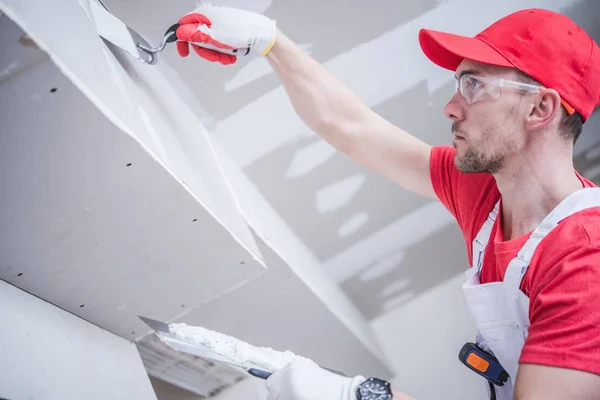
We tape and mud walls and ceilings for homes and businesses in Duluth and the communities within about 50 miles, on new drywall we hang ourselves or on board that is already up.
The three-coat process
Getting a smooth finish is about timing as much as technique. Each coat has to dry completely before the next one goes on. Rushing it traps moisture, and the joint can shrink, bubble or crack later.
- First coat: tape is bedded into joint compound over every seam, and screws and corner bead get their first pass.
- Second coat: once the first coat is dry, a wider filler coat builds up the joints and is feathered out past the tape.
- Final coat: the last coat is blended wide and thin, then sanded so the joints are flat and smooth to the touch.
Feathering: why the edges matter
The difference between a professional finish and a do-it-yourself one usually shows at the edges of each joint. Feathering means spreading the compound wider and thinner with every coat, so the joint tapers into the wall instead of standing up as a ridge. It takes a steady hand and patience, and it is what keeps seams from casting shadows when light hits the wall at an angle.
What is included
- Tape on all flat joints and inside corners
- Three coats of joint compound on joints, screws and corner bead
- Sanding between and after coats for a smooth surface
- Walls and ceilings
- Clean-up of dust and debris when the work is done
Cold weather and dry time
Joint compound dries by evaporation, so temperature and humidity matter. In a cold basement or a new build that is not heated yet, a coat that would dry overnight in summer can take much longer. Working in a heated, ventilated space keeps the schedule on track and helps the mud cure hard instead of staying soft and shrinking later. We plan the coats around the conditions in your space, not a fixed calendar.
Ready for paint
When the last coat is sanded, the walls are ready for primer and paint. We can hand the room back to you at that point or paint it ourselves, so the same crew is responsible for how the finished wall looks.
Taping and mudding is messy work, but the mess does not have to be yours. Call (218) 522-9671 or request a free estimate, and tell us about the rooms you need finished.